Sherlock4Py

 Source: GPT-5.6 Sol
🔎🐛 Sherlock4Py 🐍
MaxSAT-Based Misbehaviour Verification and Localisation Framework for Python
Sherlock4Py is a research project investigating how formal reasoning and Large Language Models (LLMs) can work together to find, explain, and repair bugs in Python programs.
The project brings together Maximum Satisfiability (MaxSAT), formal verification, software engineering, and machine learning to make Python software and AI-assisted programming more reliable.
Sherlock4Py is funded by the European Union through the Marie Skłodowska-Curie Actions (MSCA) Postdoctoral 2025 Fellowships under Horizon Europe (GA No. 101269051).
🐛 Finding Bugs with Formal Reasoning
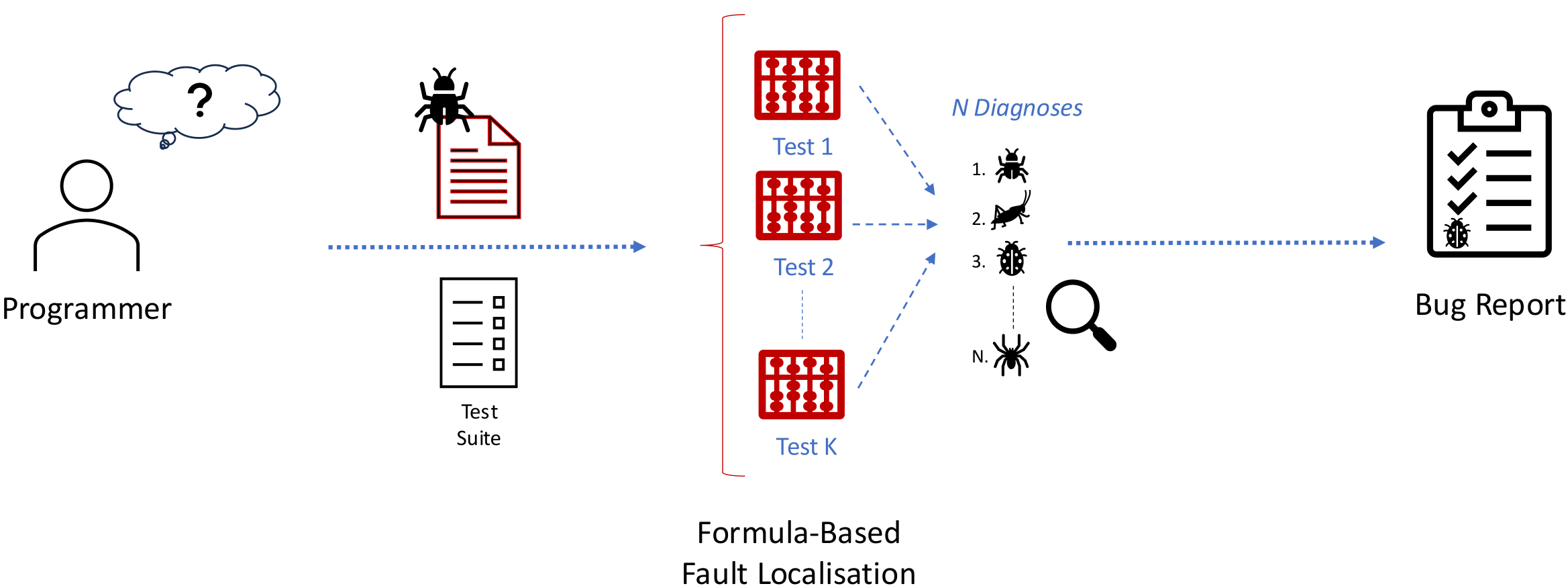
Given a buggy program and a set of failing test cases, Formula-Based Fault Localisation (FBFL) uses logical reasoning to identify the program statements that can explain the observed failures.
Program behaviour is encoded as logical constraints and techniques such as Maximum Satisfiability (MaxSAT) and Model-Based Diagnosis (MBD) are used to compute minimal sets of potentially faulty statements, known as diagnoses.
While these techniques have been successfully applied to languages such as C, Python remains comparatively underserved by exact fault-localisation methods.
At the same time, LLMs are increasingly used to generate and repair Python code, despite providing no guarantee that the generated programs are correct.
Sherlock4Py brings these two problems together.
We are investigating MaxSAT-based fault localisation for Python, new solver techniques that make this reasoning more scalable, and how precise bug diagnoses can be used to guide and verify LLM-generated program repairs.
Can exact symbolic reasoning and generative AI work together to make Python software more reliable?
🧭 Where Sherlock4Py Comes From
Sherlock4Py builds on our previous research at the intersection of formal methods, fault localisation, program repair, and LLMs.
Our work on CFaults introduced a MaxSAT-based approach for formula-based fault localisation in C programs, using multiple failing test cases simultaneously to compute precise diagnoses.
We subsequently showed that these diagnoses can guide Large Language Models for automated program repair: instead of asking an LLM to repair an entire program, MaxSAT-based fault localisation first identifies where the problem is likely to be.
With PyVeritas, we started extending these ideas towards Python by using LLMs to transpile Python programs into C and then applying bounded model checking and MaxSAT-based fault localisation.
- (2026). PyVeritas: On Verifying Python via LLM-Based Transpilation and Bounded Model Checking for C. In P-AI-FM @ AAAI 2026.
Sherlock4Py takes the next step: developing these formal reasoning techniques for Python itself, while investigating how they can provide correctness-aware guidance to AI models.
🔬 What We Have Been Working On
Since the beginning of Sherlock4Py, our work has explored several aspects of the interaction between LLMs and symbolic reasoning.
🧠 Understanding the Limits of LLMs for Code
We investigated whether LLMs genuinely reason about Python program semantics or rely partly on superficial syntactic patterns.
By applying semantics-preserving transformations to Python programs, we found that model predictions can change even when program behaviour remains identical.
Pedro Orvalho, and Marta Kwiatkowska (2025). Are Large Language Models Robust in Understanding Code Against Semantics-Preserving Mutations?. In arXiv 2025.
These results reinforce one of the motivations behind Sherlock4Py: plausible LLM-generated code is not necessarily reliable code.
🧩 Combining LLMs with MaxSAT
We have also been exploring how LLMs and exact solvers can complement each other.
At LLM-Solve @ FLoC 2026, we investigated using LLMs to translate natural-language optimisation problems into executable PySAT models, while delegating the actual optimisation to an exact MaxSAT solver.
- (2026). Solving MaxSAT Problems from Natural Language Descriptions with LLMs and PySAT. In LLM-Solve @ FLoC 2026.
The underlying philosophy is closely related to Sherlock4Py:
Use LLMs for their flexibility, and symbolic solvers for exact reasoning.
🤖 MaxSAT-Based Feedback for AI
We have also investigated MaxSAT as a mechanism for providing correctness-aware feedback to AI models.
Using Sudoku as a controlled reasoning problem, we combine Vision-Language Models with a MaxSAT oracle that identifies inconsistent predictions and provides feedback that the model can use to refine its solution.
- (2026). MaxSAT-Based Feedback for Guiding Vision-Language Models in Sudoku. In EPIA 2026.
This explores a broader idea central to Sherlock4Py:
Formal reasoning does not need to replace AI — it can guide it.
For Python program repair, we aim to use the same principle:
localise → generate → verify → provide feedback → repair
🎓 Understanding Bugs and Useful Feedback
Another part of our research investigates what bugs programmers actually write and what kinds of automated feedback are useful to them.
At ICLP 2026, we studied automated feedback for students learning Prolog and developed a data-driven taxonomy of real student bugs.
- (2026). Can Automated Feedback Turn Students into Happy Prologians?. In ICLP 2026.
Although these studies focus on Prolog, they provide useful insights for the evaluation of Sherlock4Py: fault-localisation and repair systems should be tested against realistic programmer mistakes, not only artificially constructed bugs.
📢 Dissemination
Sherlock4Py results and closely related research are disseminated through conference presentations, workshops, seminars, research visits, and open-source research artefacts.
🎤 Talks & Events
📅 September 2026
Large Language Models Are Not (Yet) Robust in Understanding Code Against
Semantics-Preserving Mutations
25th EPIA Conference on Artificial Intelligence — Funchal, Portugal,
4 September 2026.
Talk details →
MaxSAT-Based Feedback for Guiding Vision-Language Models in Sudoku
25th EPIA Conference on Artificial Intelligence — Funchal, Portugal,
2 September 2026.
Talk details →
📅 July 2026
Can Automated Feedback Turn Students into Happy Prologians?
42nd International Conference on Logic Programming (ICLP), FLoC 2026 —
Lisbon, Portugal, 21 July 2026.
Talk details →
Solving MaxSAT Problems from Natural Language Descriptions with LLMs
and PySAT
LLM-Solve @ FLoC 2026 — Lisbon, Portugal, 19 July 2026.
Talk details →
📅 May 2026
From Brittle LLM Code Reasoning to MaxSAT-Based Verified Repairs
Software Systems Engineering Seminars, University College London —
London, UK, 20 May 2026.
Talk details →
Towards Assessing and Repairing LLM-Generated Code via Model Checking
and MaxSAT-Based Fault Localisation
Dagstuhl Seminar 26192 — Evaluation of AI Models in Software Engineering —
Schloss Dagstuhl, Germany, 5 May 2026.
Talk details →
📚 Publications
Sherlock4Py & Related Research
- (2026). MaxSAT-Based Feedback for Guiding Vision-Language Models in Sudoku. In EPIA 2026.
- (2026). Solving MaxSAT Problems from Natural Language Descriptions with LLMs and PySAT. In LLM-Solve @ FLoC 2026.
- (2026). Can Automated Feedback Turn Students into Happy Prologians?. In ICLP 2026.
Research Foundations
- (2026). PyVeritas: On Verifying Python via LLM-Based Transpilation and Bounded Model Checking for C. In P-AI-FM @ AAAI 2026.
🔗 Project Information
Sherlock4Py — MaxSAT-Based Misbehaviour Verification and Localisation Framework for Python
Marie Skłodowska-Curie Postdoctoral 2025 Fellowship
Horizon Europe · Grant Agreement 101269051
Researcher: Dr. Pedro Orvalho
Supervisor: Dr. Felip Manyà
Host: Artificial Intelligence Research Institute (IIIA), Spanish National Research Council (CSIC)
Funded by
Hosted by

Interested in MaxSAT, fault localisation, Python verification, program repair, or neuro-symbolic AI?
Feel free to reach out 📧 if you are interested in discussing these topics or exploring potential collaborations.
