
📄 Paper accepted @ AAAI 2025!! 🎉
I am very happy to share that our paper that combines the strengths of both MaxSAT-based fault localisation and Large Language Models, via zero-shot learning, to enhance automated …

I am very happy to share that our paper that combines the strengths of both MaxSAT-based fault localisation and Large Language Models, via zero-shot learning, to enhance automated …
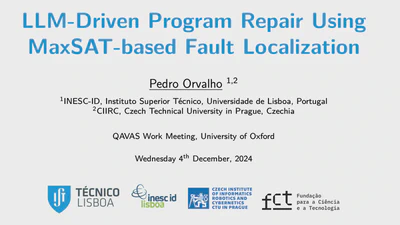
In this talk I will present a hybrid method to automated repair of C code, using Maximum Satisfiability (MaxSAT)-based fault localization, CFaults, to localize bugs and LLMs to …
Delivering valuable and personalised feedback to students remains one of the greatest challenges in programming education, particularly in courses with large enrollments. Providing …

In this talk I will present C-Pack-IPAs, a publicly available benchmark comprising student-program submissions for 25 distinct introductory programming assignments (IPAs).

A C90 Program Benchmark of Introductory Programming Assignments (IPAs), that contains semantically correct, semantically incorrect, and syntactically incorrect programs and a test …

In this work, we propose using graph neural networks (GNNs) to map the set of variables between two programs based on both programs' abstract syntax trees (ASTs). To demonstrate …
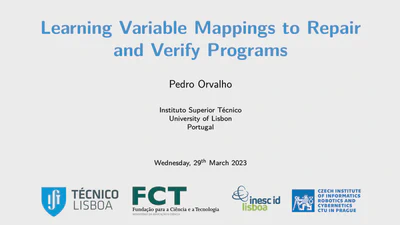
In this talk I will propose using graph neural networks (GNNs) to map the set of variables between two programs based on both programs' abstract syntax trees (ASTs).

This paper presents MultIPAs, a program transformation tool that can augment IPAs benchmarks by (1) applying six syntactic mutations that conserve the program's semantics and (2) …
In this talk I propose to learn how to map the set of variables between different small imperative programs based on both programs' abstract syntax trees (ASTs) using graph neural …
In this position paper, we propose to learn how to map the set of variables between different small imperative programs based on both programs' abstract syntax trees (ASTs) using …
In this talk I propose a novel approach for program clustering that uses dynamically generated program invariants to cluster semantically equivalent programming assignments.