📄📄📄 3 Papers accepted @ FLoC 2026!! 🎉🎉🎉
Excited to share that three of our papers have been accepted at FLoC 2026, covering automated feedback for Prolog education, data-driven mutation testing for Prolog, and …
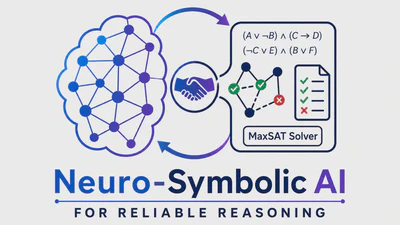
In this paper, we study a neuro-symbolic approach in which an LLM translates a natural language description of an optimisation problem into executable Python code using PySAT. The …
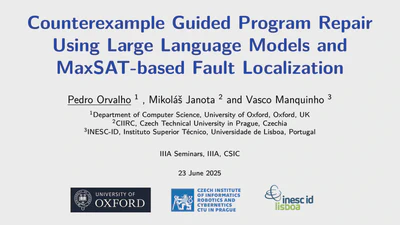
In this talk I will present a hybrid method to automated repair of C code, using Maximum Satisfiability (MaxSAT)-based fault localization, CFaults, to localize bugs and LLMs to …
In my talk, I will present MENTOR, a semantic automated program repair (APR) framework designed to provide Automated Feedback for Introductory Programming Exercises.
In this talk I will present our novel approach that combines the strengths of both FM-based fault localization and LLMs, via zero-shot learning, to enhance Automated Program …
In this talk I will present a hybrid method to automated repair of C code, using Maximum Satisfiability (MaxSAT)-based fault localization, CFaults, to localize bugs and LLMs to …
The Maximum Satisfiability (MaxSAT) problem is the optimisation variant of the Satisfiability (SAT) problem. Solving MaxSAT efficiently often involves partitioning the set of soft …
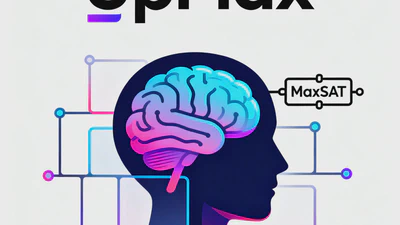
In this talk I will present a new framework called UpMax that decouples the partitioning procedure from the MaxSAT solving algorithms.
This paper proposes a new framework called UpMax that decouples the partitioning procedure from the MaxSAT solving algorithms. As a result, new partitioning procedures can be …
We propose AlloyMax, an extension of Alloy with a capability to express and analyze problems with optimal solutions. AlloyMax introduces (1) a small addition of language constructs …